
Sometimes the most important race in life is the one you run for someone else.
Runner is the kind of movie that knows exactly what it wants to be. It is fast, violent, funny at times, unrealistic at other times, and built around an old-fashioned action-movie premise: get from Point A to Point B while seemingly everybody in between is trying to stop you.
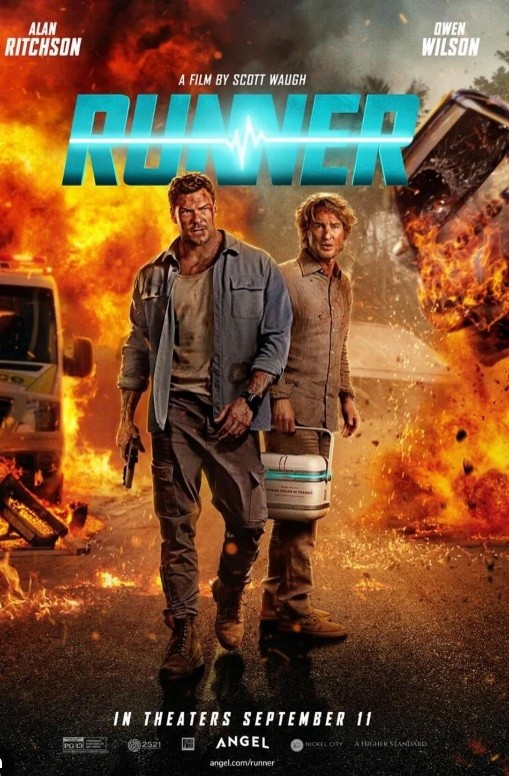
Directed by Scott Waugh and starring Alan Ritchson as Hank Malone and Owen Wilson as Ben Bishop, the movie centers on a life-or-death delivery. Hank, a former soldier, becomes responsible for transporting a donor liver desperately needed by a sick little girl. What should have been a straightforward mission becomes a deadly race against time when dangerous people decide they want the organ for themselves. From that point forward, Runner rarely slows down.
But underneath all the gunfire, car chases, fights, jokes, and explosions is actually a simple moral question: How far are you willing to go to save the life of someone you do not know? That is where I found the movie more interesting than the typical action film.
THE MOVIE
Alan Ritchson is comfortably in his wheelhouse. Anyone familiar with him from Reacher knows that he can convincingly walk into a room and make you believe that several unfortunate people are about to have a very bad day.
He brings that same physical presence to Hank Malone. Owen Wilson provides the contrast. His Ben Bishop is not another version of Hank. Wilson brings his familiar humor and easygoing personality, which keeps the movie from becoming ninety-plus minutes of grim violence. The chemistry between Ritchson and Wilson is probably the movie’s greatest strength.
The story itself is not particularly complicated, nor is it always believable. There are moments when you simply have to remind yourself, “It’s an action movie, just go with it.” And I did. The action sequences are well executed, the movie moves quickly, and at approximately an hour and a half, it does not overstay its welcome. Is it groundbreaking? No. Is it believable? Not particularly. Is it entertaining? Yes. But what caught my attention was the moral foundation underneath the ridiculous circumstances.
THE VALUE OF ONE LIFE
The entire movie revolves around something remarkably small compared with all the chaos surrounding it: one human life. People are fighting, killing, chasing, betraying, and risking everything because somewhere at the end of the journey is a little girl who needs that liver to survive. That reminded me of Jesus’ words: “Are not two sparrows sold for a penny? And not one of them will fall to the ground apart from your Father.” – Matthew 10:29 (ESV)
The world often measures people according to wealth, influence, position, usefulness, or power. God does not. One child whom Hank has never met becomes worth risking his own life to save. There is something profoundly biblical about that idea. Jesus repeatedly demonstrated that individual people matter. He stopped for the blind man others wanted silenced. He spoke with the Samaritan woman others would have avoided. He noticed Zacchaeus sitting in a tree. He allowed the woman suffering from bleeding to interrupt Him on His way to another emergency. God sees individuals.
Runner, intentionally or unintentionally, reminds us that sometimes the worth of our mission is determined not by how many people are watching but by the value of the person waiting at the other end.
SACRIFICE
Another theme running through the movie is sacrifice. Hank could walk away. There are multiple opportunities when self-preservation would be the logical decision. But once someone else’s life has been placed into his hands, the mission becomes personal. That brings to mind Jesus’ words: “Greater love has no one than this, that someone lay down his life for his friends.” – John 15:13 (ESV)
The interesting thing about Runner is that the person being saved is not initially Hank’s friend. She is essentially a stranger. That makes the lesson even stronger. Christian love is not limited to people we know, people we like, or people who can repay us. The Good Samaritan did not know the wounded man lying beside the road. He simply saw someone who needed help. And he stopped. Sometimes love looks like affection. Sometimes love looks like compassion. And sometimes love looks like accepting responsibility when walking away would be much easier.
EVERYBODY IS RUNNING AFTER SOMETHING
The title also lends itself to another lesson. Everybody in this movie is running. Some are running to save a life. Others are running to serve themselves. That distinction matters. Life is filled with people running after something, money, success, recognition, power, pleasure, security, revenge, acceptance. Scripture asks us to examine what we are pursuing. Paul wrote: “I have fought the good fight, I have finished the race, I have kept the faith.” – 2 Timothy 4:7 (ESV)
Notice that Paul was not simply concerned with finishing. He was concerned with what kind of race he had run. You can spend your entire life running at full speed and still discover that you were running in the wrong direction. That may be the biggest lesson I took from Runner: It is not enough to run. You need something worth running for. Hank eventually has that. A child’s life is waiting at the finish line.
THE VILLAINS PRESENT THE OPPOSITE PHILOSOPHY
The villains represent another worldview entirely. Their philosophy is essentially: If I have enough money and power, my life or the life of someone important to me is worth more than yours. Scripture rejects that idea. “For God shows no partiality.” – Romans 2:11 (ESV). Human beings constantly construct hierarchies of value. Rich over poor. Powerful over powerless. Connected over forgotten. But before God, the billionaire and the child lying in a hospital bed possess the same fundamental human dignity because both bear the image of their Creator.
The battle over that donor organ therefore becomes more than an action-movie plot device. It becomes a question of whose life matters. And the biblical answer is: Both lives matter. The tragedy comes when human beings decide that their power gives them the right to sacrifice someone else for themselves.
FINAL THOUGHTS
Runner is not a deep theological movie. Nobody should walk into the theater expecting The Ten Commandments with car chases. It is an action-comedy.
And it behaves like one. Some situations stretch credibility. Some characters could have been developed more. The violence may also be more than some viewers will appreciate despite the PG-13 rating. But I enjoyed the pairing of Alan Ritchson and Owen Wilson, and the movie delivers enough action, humor, and momentum to accomplish what it sets out to do.
More importantly, beneath all the chaos I found a surprisingly worthwhile message: A human life has value. Sometimes doing the right thing costs you something. Sometimes responsibility arrives when you did not ask for it. Sometimes helping another person means accepting inconvenience, danger, or sacrifice. And sometimes you simply must keep moving because somebody is depending on you.
The Christian life is also described as a race. But Scripture tells us where our eyes should be while we run: “Let us run with endurance the race that lies before us, looking to Jesus, the founder and perfecter of our faith.” – Hebrews 12:1–2 (ESV)
Runner gives us people desperately racing toward a hospital. The Christian is running toward something greater. The question each of us eventually has to answer is: What am I running after—and will it have been worth the race when I reach the finish line?
My recommendation: Worth seeing for fans of old-fashioned action movies, especially if you enjoy Alan Ritchson and Owen Wilson.
Entertainment: ★★★½☆
Story: ★★★☆☆
Action: ★★★★☆
Biblical/Moral Discussion Value: ★★★★☆
Overall: 3½ out of 5 stars.
Bottom Line: Runner may look like a movie about delivering an organ while outrunning bad guys, but underneath the explosions is a worthwhile reminder: when God places an opportunity before us to protect, serve, or help another person, the most important question may not be, “What will this cost me?” But “Whose life might be changed if I keep running?”
Be the first to know about our latest updates, tips and special offers.
Copyright © 2022 All Rights Reserved
Website designed by Red Robin Designers.