
Movie Overview:
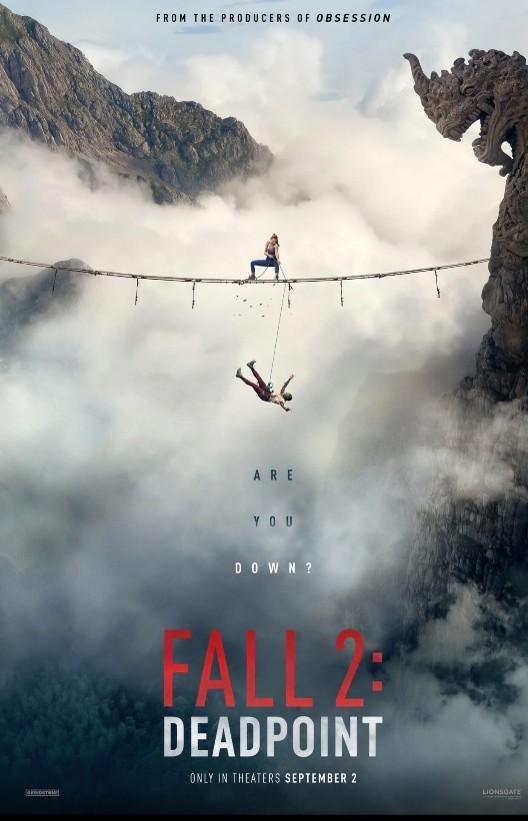
Fall 2: Deadpoint is a 2026 survival thriller and sequel to the 2022 film Fall. Directed by Michael and Peter Spierig and written by Scott Mann and Jonathan Frank, the film stars Harriet Slater as Jax Hunter and Arsema Thomas as Luce.
Like the original, Fall 2 takes a simple human fear, the fear of falling from an extreme height, and turns it into a sustained survival story. Critics have been divided: some regard the sequel as repetitive and implausible, while others praise its suspense and its attempt to connect physical survival with grief, fear, and character development.
For a Christian audience, the movie becomes more interesting when viewed not merely as a thriller but as a story about grief, fear, choices, consequences, trust, courage, truth, and the difference between bravery and recklessness.
Overall Rating: 3 out of 5 Stars
Brief Summary:
Jax Hunter is grieving the death of her sister, Shiloh, whose adventurous lifestyle connects the sequel to the events of the first film. Jax meets Luce, her sister’s thrill-seeking friend, and the two decide to honor Shiloh by undertaking one of the adventures she had planned: a dangerous mountain climb and plank walk in Thailand. Jax is hardly the natural person for such an undertaking. She struggles with fear and unresolved emotions. Nevertheless, she agrees to make the climb.
The situation becomes catastrophic when a rockslide destroys portions of their route and leaves Jax and Luce stranded thousands of feet above the ground. What began as an attempt to honor someone they loved becomes a desperate struggle for survival. They must confront not only the physical dangers surrounding them but also grief, fear, strained relationships, difficult truths, and the consequences of earlier decisions.
The result is essentially a survival story built around a deeper question: What happens when the things we have avoided emotionally can no longer be avoided? That question provides several useful points of connection for a Bible study.
Life Lesson 1: Courage Is Not the Absence of Fear
One of the clearest themes in Fall 2 is Jax’s struggle with fear. Her circumstances eventually force her to act despite being terrified. One review specifically notes that the ordeal tests Jax’s bravery and develops into a genuine character arc.
There is an important biblical distinction here. Scripture does not teach that faithful people never experience fear. It teaches us where to turn when fear comes. Psalm 56:3-4 (ESV): “When I am afraid, I put my trust in you. In God, whose word I praise, in God I trust; I shall not be afraid. What can flesh do to me?”
Notice that David does not say, “I am never afraid.”
He says, “When I am afraid.”
Faith is demonstrated by what we do with our fear.
Bible Study Principle: Courage is moving forward in obedience despite fear because our confidence ultimately rests in God.
Joshua faced this challenge when God told him: Joshua 1:9 (ESV): “Have I not commanded you? Be strong and courageous. Do not be frightened, and do not be dismayed, for the LORD your God is with you wherever you go.” The Christian’s confidence is therefore not simply, “I can do this.” It is: “God is with me.”
Life Lesson 2: Courage and Recklessness Are Not the Same Thing
This may be the film’s strongest lesson for a Bible class. Jax and Luce knowingly undertake an extremely dangerous activity. Their motivations are understandable, they are dealing with grief and trying to honor someone they loved but good intentions do not automatically make a decision wise.
Several critics point directly to the characters’ questionable or reckless decision-making. That creates an important biblical discussion: When does courage become foolishness? Scripture praises courage, but it also praises wisdom. Proverbs 22:3 (ESV): “The prudent sees danger and hides himself, but the simple go on and suffer for it.”
Biblical faith is not recklessness disguised as spirituality. Jesus demonstrated this principle when Satan tempted Him to throw Himself from the pinnacle of the temple. Satan even quoted Scripture while encouraging Jesus to place Himself unnecessarily in danger.
Jesus answered: Matthew 4:7 (ESV): “Again it is written, ‘You shall not put the Lord your God to the test.’” There are situations in which Christians must courageously face danger. But there is a difference between accepting necessary risk in obedience to God and creating unnecessary danger and expecting God to rescue us.
Bible Study Principle: Faith trusts God when danger comes; wisdom does not unnecessarily manufacture the danger.
Life Lesson 3: Grief Can Influence Our Decisions
Beneath the survival plot is a story about grief. Jax has not simply lost her sister. She carries unresolved emotions connected to that relationship. Luce is grieving too. Their dangerous journey becomes partly an attempt to remain connected to the person they lost. That raises an important pastoral issue. People sometimes make major decisions while grieving because they are trying to relieve emotional pain, preserve a connection with the deceased, or find meaning in their loss.
Scripture never treats grief as weakness. When Lazarus died, John 11:35 (ESV), “Jesus wept.” Christ knew Lazarus would soon be raised, yet He still entered into the sorrow of those around Him. Paul likewise tells Christians in Romans 12:15 (ESV): “Rejoice with those who rejoice, weep with those who weep.”
Bible Study Principle: Grief should be processed honestly rather than allowed silently to control our decisions. The church should therefore be a community in which grieving people do not have to pretend that they are fine.
Life Lesson 4: Your Decisions Can Put Other People at Risk
One of the uncomfortable lessons of survival movies is that an individual’s decision rarely affects only that individual. One person’s choice can place friends, family members, rescuers, coworkers, or even strangers in danger.
Scripture repeatedly teaches that human beings are interconnected. Paul writes in Romans 14:7 (ESV): “For none of us lives to himself, and none of us dies to himself.” Before making a major decision, Christians should therefore ask more than: “Can I do this?” We should also ask: “Who else could be affected if I do this?” Paul expresses a similar principle: “Let each of you look not only to his own interests, but also to the interests of others.” Philippians 2:4 (ESV)
Bible Study Principle: Maturity considers the consequences our choices may have on other people.
Life Lesson 5: Crisis Reveals Character:
When everything is comfortable, people can hide weakness, resentment, dishonesty, selfishness, or fear. Crisis removes many of those disguises. Once Jax and Luce become trapped, survival requires difficult choices. Their ordeal forces vulnerabilities and truths to the surface. Scripture frequently presents trials in similar terms.
James 1:2–4 (ESV): “Count it all joy, my brothers, when you meet trials of various kinds, for you know that the testing of your faith produces steadfastness.” James does not say that suffering itself is pleasant. Instead, God can use trials to produce something within us that comfort often cannot.
Bible Study Principle: Trials do not merely test what we say we believe; they reveal what we actually trust.
That makes a valuable personal question: What comes out of me when life does not go according to plan?
Life Lesson 6: We Need Other People
The survival situation repeatedly requires cooperation. Neither woman can simply pretend that she is completely self-sufficient. That corresponds beautifully with the biblical understanding of community.
Ecclesiastes 4:9–10 (ESV): “Two are better than one, because they have a good reward for their toil. For if they fall, one will lift up his fellow.”
That passage becomes especially memorable when paired with a movie literally centered on people desperately trying not to fall.Our culture often celebrates radical independence. Scripture instead teaches interdependence. Christians need one another for encouragement, correction, prayer, wisdom, accountability, and support.
Bible Study Principle: God never intended the Christian life to be lived alone.
Life Lesson 7: Fear Can Either Control Us or Teach Us
Jax’s fear initially functions as something she wants to escape. Eventually she has to confront it. Fear itself is not always the enemy. Sometimes fear is a warning. Proverbs says:
Proverbs 14:16 (ESV): “One who is wise is cautious and turns away from evil, but a fool is reckless and careless.”
This creates an interesting distinction for a Bible class. Some fears need to be overcome. Other fears need to be heeded. The spiritual challenge is learning the difference. Fear of obeying God may need to be conquered. Fear warning us about an irresponsible decision may be wisdom sounding an alarm.
Life Lesson 8: Survival Is Not the Same as Healing
Perhaps the most significant spiritual observation we can draw from Fall 2 is that escaping physical danger does not automatically resolve emotional wounds. A person can survive the crisis and still carry grief, guilt, anger, regret, or broken relationships. Christianity offers something deeper than survival. David prayed:
Psalm 147:3 (ESV): “He heals the brokenhearted and binds up their wounds.”
The gospel does not promise believers a life without wounds. It reveals a God who meets us in our brokenness and ultimately redeems what suffering has damaged.
Overall Review
As a thriller, Fall 2: Deadpoint appears to be a mixed success. The high-altitude photography and survival sequences can produce genuine tension, particularly for viewers uncomfortable with heights. However, the premise closely resembles the original Fall, and several critics have criticized the repetitive dangers, implausible decisions, and thin dialogue.
For a Bible-study discussion, however, the movie provides more material than its straightforward survival-thriller premise might suggest. Its greatest spiritual value lies in the questions it raises about fear, grief, wisdom, courage, relationships, consequences, and perseverance.
I would summarize its central life lesson this way: Courage is not recklessly proving that we are unafraid. Biblical courage is facing what must be faced, exercising wisdom about what should be avoided, and trusting God when circumstances exceed our ability to control them.
Bible Study Discussion Questions
A final question: “When you are standing at the edge of something frightening in your own life, how do you determine whether God is calling you to step forward in faith – or wisdom is telling you to step away?”
That question could turn Fall 2: Deadpoint from a discussion about a survival thriller into a meaningful study of biblical courage and godly wisdom.
Be the first to know about our latest updates, tips and special offers.
Copyright © 2022 All Rights Reserved
Website designed by Red Robin Designers.