
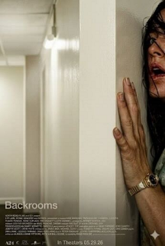
Review of Backrooms (2026)
Directed by Kane Parsons and produced by James Wan, Backrooms is one of the most unusual horror films of 2026. Based on Parsons’ viral YouTube series, the movie transforms an internet urban legend into a psychological and existential horror story.
Starring Chiwetel Ejiofor and Renate Reinsve, the film relies less on jump scares and more on atmosphere, isolation, and the fear of losing one’s grip on reality.
Brief Summary
The story centers on Clark, a failed architect and furniture store manager whose life is already unraveling. While investigating a strange doorway in the basement of his furniture showroom, he discovers an endless labyrinth of empty rooms, hallways, and distorted spaces known as the Backrooms.
As Clark ventures deeper into this bizarre dimension, he becomes trapped. His therapist, Dr. Mary Kline, enters the mysterious realm in an attempt to rescue him, only to find herself caught in a nightmare where reality, memory, and identity begin to blur.
Rather than explaining everything, the film embraces ambiguity. The Backrooms become a symbol of confusion, despair, obsession, and humanity’s search for meaning in a world that often seems disorienting and empty.
Review
What makes Backrooms effective is its restraint. Instead of relying on monsters or graphic violence, it creates dread through endless fluorescent corridors, monotonous yellow walls, and spaces that seem familiar yet profoundly wrong. The environment itself becomes the villain.
Ejiofor gives a compelling performance as a man burdened by failure, regret, and loneliness. Reinsve provides an emotional anchor as a therapist who seeks to help another person while confronting her own fears. Together they carry a story that is less about survival and more about confronting the unknown.
The film’s greatest strength is its atmosphere. Viewers who enjoy traditional horror may find its pace slow and its ending frustratingly open-ended. However, those who appreciate psychological horror and thought-provoking themes will likely find it deeply unsettling and memorable.
Rating: 4 out of 5 stars
Life Lessons from the Film
Clark enters the Backrooms partly because he is dissatisfied with his life. What begins as curiosity becomes obsession.
The film suggests that running from our problems often leads us into deeper confusion rather than freedom.
Many people today attempt to escape pain through distractions, addictions, endless entertainment, or fantasy worlds. The movie reminds us that avoiding reality rarely solves anything.
The endless rooms are frightening because Clark and Mary are separated from meaningful human connection. The film underscores a timeless truth: people were not created to live alone.
Fear often grows in isolation, while hope grows in community.
The mysterious doorway represents humanity’s temptation to pursue knowledge or experiences without considering the consequences. Curiosity is valuable, but wisdom must guide it.
The Backrooms repeatedly ask the question: “Just because something can be explored, should it be?”
The Backrooms are sterile, repetitive, and purposeless. They are spaces without beauty, love, or transcendence. The horror emerges not merely from danger but from meaninglessness.
The film implicitly reminds viewers that human beings long for purpose. We are not satisfied by endless corridors of existence; we seek significance.
What Christians Can Take Away from the Film
Although Backrooms is not a Christian film, believers can find several thought-provoking themes.
The Backrooms present a world devoid of purpose and direction. Scripture teaches the opposite.
“He has put eternity into man’s heart, yet so that he cannot find out what God has done from the beginning to the end.” (Ecclesiastes 3:11, ESV)
Human beings instinctively search for meaning because God created them for relationship with Him. The emptiness of the Backrooms highlights what life becomes when ultimate purpose is absent.
The central experience of the film is being lost. Characters wander endlessly, searching for an exit.
Christians recognize a spiritual parallel. Humanity is lost apart from God.
Jesus said to him,
“I am the way, and the truth, and the life. No one comes to the Father except through me.” (John 14:6, ESV)
The film portrays people searching desperately for a way out; Christianity proclaims that God Himself has provided the way.
The Backrooms are filled with artificial fluorescent light, yet they remain spiritually dark. The film subtly illustrates that physical light is not the same as true light.
Jesus declared:
“I am the light of the world. Whoever follows me will not walk in darkness, but will have the light of life.” (John 8:12, ESV)
The movie’s eerie illumination serves as a reminder that only Christ provides genuine spiritual clarity.
One of the most striking aspects of Backrooms is the sense of hopelessness that permeates its world. Christianity offers a direct contrast.
“The LORD is my light and my salvation; whom shall I fear?” (Psalm 27:1, ESV)
Where the film leaves many questions unresolved, the Christian worldview offers confidence that God remains sovereign even when circumstances appear confusing and frightening.
Final Thoughts
Backrooms succeeds because it taps into a modern anxiety: the fear of being lost in a world that feels increasingly impersonal, confusing, and disconnected. Beneath its horror elements lies a meditation on loneliness, purpose, and the search for meaning.
The film’s endless corridors become a metaphor for life without direction.
For Christian viewers, the movie can serve as a powerful contrast between a world of endless wandering and the biblical promise that God provides purpose, truth, and a way home.
The Backrooms depict humanity trapped in a maze; the gospel proclaims that the Shepherd still seeks the lost and leads them out of darkness into His marvelous light. (See 1 Peter 2:9, ESV.)
Be the first to know about our latest updates, tips and special offers.
Copyright © 2022 All Rights Reserved
Website designed by Red Robin Designers.