
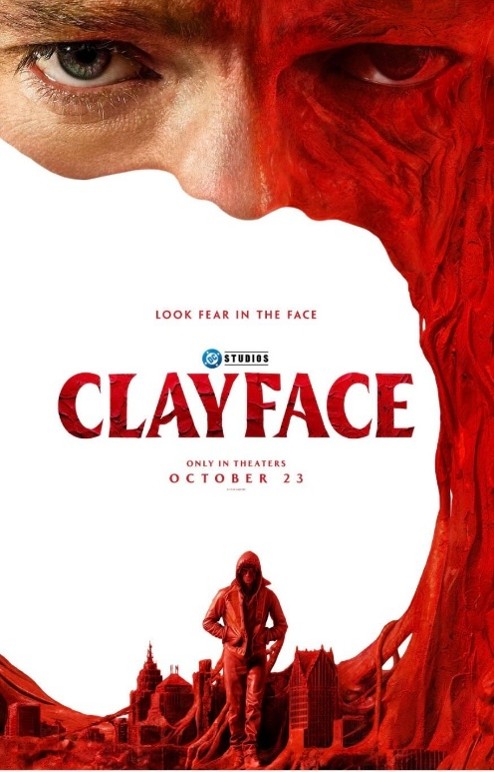
Movie Review | DC Studios | October 23, 2026
Overall Review: 4 out of 5 stars
SPOILER ALERT: This review discusses major plot developments, the experimental medical procedure, and the decisions that lead to Clayface’s transformation. If you have not seen the movie and want to experience the story without knowing what happens, I recommend watching it before reading further.
Movie Summary: The Tragedy Behind the Monster
Most Batman fans know Clayface as one of the Dark Knight’s most unusual and formidable enemies. His ability to transform his appearance makes him a dangerous adversary. But Clayface gives us an opportunity to look beyond the villain and consider the human being behind the monster.
At the center of the story is a successful actor whose life changes dramatically after a violent encounter leaves his face disfigured.
For someone whose career, livelihood, and identity are closely connected to his appearance, the injury represents far more than a physical wound. It threatens everything he has worked to achieve.
Suddenly, a man who once enjoyed success, recognition, and opportunity finds himself facing a future he never imagined.
Desperate to reclaim his former life, he encounters a young doctor working on an experimental treatment that might restore what he has lost.
There is one significant problem: the procedure has not been approved for human trials.
Nevertheless, he agrees to take the risk. His desperation has reached the point where even death seems preferable to his present circumstances.
Initially, the treatment appears promising. But complications and side effects begin to test his patience.
Rather than allowing the treatment to proceed as recommended, he takes matters into his own hands, administering far more of the experimental serum than prescribed. That decision has devastating and permanent consequences.
The result is the creation of Clayface, a man whose desperate attempt to reclaim his former identity ultimately transforms him into something he never intended to become.
The movie is therefore more than a comic-book origin story. It is a tragedy about loss, identity, desperation, impatience, and the consequences of decisions made when our emotions overpower our judgment.
The Deeper Questions Raised by Clayface
What makes this movie especially thought-provoking is that it raises questions extending far beyond the fictional world of Gotham City.
Imagine waking up one morning and discovering that the things you believed were secure, your career, your financial stability, your reputation, your physical abilities, or even your relationships have been dramatically altered.
Who are you when the things that once defined you are gone? Clayface’s tragedy begins with a physical injury, but the deeper wound is to his identity. He appears to have connected his sense of personal worth so closely to his career and appearance that losing those things makes him feel as though he has lost himself.
Life lesson: Never build your entire identity around something that circumstances can take away.
For Christians, this brings to mind Jesus’ teaching in Matthew 6:19–21 about storing up treasures in heaven rather than depending entirely on earthly treasures that can be destroyed or lost.
But this principle is universal. Careers end. Wealth fluctuates. Health changes. Relationships evolve. The person who knows that their worth extends beyond these circumstances is better prepared to survive life’s unexpected losses.
This may be the most important question in the movie. When Clayface is offered an experimental procedure, he recognizes the danger. Yet he believes he has so little left to lose that almost any risk seems acceptable. His willingness to gamble with his life reveals how desperation can alter our perception of what is reasonable. And isn’t that something we see in everyday life?
People sometimes make dangerous financial investments to recover money they have lost. Others enter unhealthy relationships because they fear being alone. Some compromise their principles to regain professional standing or social acceptance.
The desire to recover what we have lost is understandable. But that desire can become destructive when we convince ourselves that getting back what we once had is worth any price.
Life lesson: Desperation can make a dangerous decision look like the only available solution.
Proverbs 14:12 (ESV) reminds us: “There is a way that seems right to a man, but its end is the way to death.”
Sometimes the most dangerous decisions are not made because we fail to recognize the risks. They are made because we convince ourselves that the potential reward justifies ignoring them.
One of the great ironies of the film is that the treatment Clayface pursues to restore his life ultimately contributes to destroying the very life he hopes to recover. And the important distinction is that the treatment initially appears to be working. His downfall is not simply that he pursued an experimental solution. It is also that he became unwilling to accept the limitations and patience required by that solution. When the results did not come quickly enough, he decided to accelerate the process.
Instead of following the recommended dosage, he administered an excessive amount of the serum. He wanted the results without enduring the process. How often do we see that same behavior in our own lives?
We want financial security without years of disciplined saving. We want restored relationships without the difficult work of rebuilding trust. We want healing without allowing time for recovery. We want success without the preparation required to sustain it.
Life lesson: A potentially good solution can become destructive when we abandon discipline, wisdom, and patience.
Galatians 6:9 (ESV) encourages us: “And let us not grow weary of doing good, for in due season we will reap, if we do not give up.”
There are times when progress is taking place even though we cannot yet see the full results. Impatience can cause us to destroy something that was actually moving in the right direction.
This is perhaps the most fascinating moral question in the movie. There is a difference between taking a courageous risk and making a reckless decision. Faith does not require the absence of uncertainty. But neither should faith be confused with ignoring sound advice, established safeguards, or foreseeable consequences.
Clayface’s initial willingness to undergo an unapproved procedure could be interpreted as an act of extraordinary hope, although it also reflects profound desperation. However, his subsequent decision to disregard the prescribed dosage is much harder to defend. At that point, his actions appear to move beyond calculated risk into reckless disregard for his own safety.
Life lesson: Courage is not the same thing as recklessness, and faith should not be used as an excuse for poor judgment.
Proverbs 19:2 (ESV) offers an especially relevant warning: “Desire without knowledge is not good, and whoever makes haste with his feet misses his way.”
A person can sincerely believe in a desired outcome and still choose the wrong path to achieve it.
Clayface becomes so consumed with reclaiming the life he once knew that he struggles to imagine living any other kind of life. His objective is not simply to heal. It is to return to the past. But what if returning to the past is no longer possible?
This is a question many people eventually face, whether through aging, illness, disability, divorce, retirement, bereavement, or unexpected personal setbacks. There is nothing wrong with grieving what we have lost. Grief is a natural response to meaningful loss. The danger arises when our attachment to the past prevents us from recognizing the possibilities that still exist in the present.
Life lesson: Sometimes healing begins when we stop demanding that life return to what it was and begin discovering what life can become.
Isaiah 43:19 (ESV) declares: “Behold, I am doing a new thing; now it springs forth, do you not perceive it?”
Although that passage speaks to God’s promises to His people in its original context, it also encourages reflection on our tendency to overlook new possibilities while longing for what has been lost. A changed life is not necessarily a life without meaning, purpose, or value.
Perhaps the greatest tragedy of Clayface is that his desire is initially understandable.
He wants to be whole again.
He wants to work again.
He wants to be recognized as the person he once was.
Those are deeply human desires. But somewhere along the way, his desire for restoration becomes an obsession. He is no longer simply pursuing healing. He is willing to sacrifice almost anything to achieve it. And that raises an uncomfortable question: Can we become so determined to recover what we lost that we end up losing even more? The answer, unfortunately, is yes.
A person can become so consumed with recovering lost money that they gamble away their remaining savings. Someone can become so obsessed with saving a relationship that they sacrifice their dignity and emotional well-being. Another person can become so determined to preserve a professional reputation that they compromise their integrity.
The goal may begin as something reasonable, but the methods can eventually become destructive. The lesson is that we must continually examine not only what we are pursuing but also what our pursuit is costing us.
Final Reflection: The Monster Within
There is one final lesson that I believe deserves special attention. Clayface did not begin his journey wanting to become a monster. He began wanting his life back. That is what makes his story so tragic.
Sometimes the greatest danger in life is not what happens to us, but what we allow what happened to us to turn us into. We may not be able to control every tragedy, injustice, disappointment, or loss that comes our way. But we still have a responsibility to consider how we respond. And there is an important distinction between acknowledging someone’s suffering and excusing the destructive choices that follow.
For Christians, James 1:19-20 reminds us to be slow to anger, while Proverbs 3:5-6 teaches us to trust the Lord rather than relying entirely on our own understanding. For everyone, regardless of religious belief, the principle remains relevant: seek wise counsel, practice patience, recognize your limitations, and never allow desperation to become the sole authority guiding your decisions.
My greatest takeaway from Clayface is this: Sometimes life takes away something we desperately want to keep. But in our determination to get it back, we must be careful not to sacrifice the very things that make life worth living, our judgment, our character, our relationships, and our humanity.
And perhaps the most important question of all is not, “How far would I go to get my old life back?” It is: “If I cannot get my old life back, can I find the courage, wisdom, and faith to build a meaningful new one?” That is the question Clayface left me thinking about.
Final verdict: 4 out of 5 stars. An engaging, disturbing, and thought-provoking movie that offers far more than the origin story of one of Batman’s most recognizable adversaries.
Be the first to know about our latest updates, tips and special offers.
Copyright © 2022 All Rights Reserved
Website designed by Red Robin Designers.