My rating: 4½ out of 5 stars
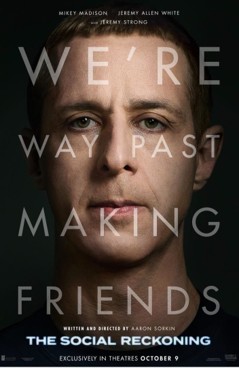
I went to see The Social Reckoning expecting a movie about Facebook. I left thinking about something much bigger: the responsibility that comes with having the power to influence people and what happens when protecting profits becomes more important than protecting people. I thought this was an excellent movie. I give it 4½ out of 5 stars, especially for its strong social message and the difficult questions it leaves us to consider.
A brief summary
Written and directed by Aaron Sorkin, The Social Reckoning is a drama inspired by true events and a companion to The Social Network. It follows Facebook employee Frances Haugen, played by Mikey Madison, as she works with Wall Street Journal reporter Jeff Horwitz, played by Jeremy Allen White, to expose closely guarded information about the company. Their story brings the conflict between corporate interests and public accountability into focus. (thesocialreckoning.movie)
For me, the larger story is about what people do when they recognize harm. When you have information, influence, and an opportunity to intervene, what responsibility do you have to act?
Responsibility does not stop with the person posting
People are responsible for what they write, share, encourage, and do. Someone who posts threats or promotes violence cannot simply blame a social media company for their decisions. But that does not end the conversation. What responsibility belongs to the company providing the platform? That question becomes even more serious when we consider the difference between allowing someone to post something and designing a system that recommends it, expands its audience, or repeatedly puts it in front of people.
To me, there is a meaningful difference between hosting a conversation and helping that conversation spread. When a company benefits from the attention harmful content receives, we should be willing to examine its decisions. Responsibility can be shared without being identical. Holding a platform accountable does not excuse the individual. Holding the individual accountable does not automatically excuse the platform.
When profit becomes the deciding factor
One of the strongest issues I took from this movie is the danger of allowing money to become the final measure of what is acceptable. Making money is not inherently wrong. Businesses need revenue. But financial success does not settle the question of whether a business practice is responsible.
What happens when outrage attracts attention? What happens when keeping people angry or afraid keeps them engaged? And what happens when reducing harm might also reduce profits? Those are uncomfortable questions because they ask us to look beyond what a company says it values and examine what it is willing to sacrifice.
Knowing about harm creates a moral challenge
There is a difference between not knowing something is happening and knowing about it but choosing to look away. For me, the movie raises a powerful question: If you recognize a serious danger and have a reasonable opportunity to reduce it, can you claim innocence simply because you did not personally create the original problem?
That does not mean a company can predict every harmful act or prevent every tragedy. It does mean that knowledge and the ability to act should matter when we assess responsibility. Sometimes the moral failure is a decision to do something harmful. Sometimes it is a decision to keep benefiting while someone else pays the price.
The difficult questions that stayed with me
The movie prompted me to wrestle with questions that reach well beyond Facebook:
These questions do not all have easy answers. But difficulty cannot become an excuse for refusing to address them.
A lesson for all of us
Although this movie focuses on a powerful corporation, I believe its message reaches leaders, churches, businesses, families, and individuals. We all make decisions about what we tolerate, what we encourage, and when we speak up. We may not control a global platform, but we have influence somewhere. From my Christian perspective, that raises a question of stewardship: What are we doing with the influence entrusted to us? Loving our neighbors should affect how we treat people online, what we pass along, and whether we are willing to challenge something harmful even when doing so costs us something.
My final assessment
What made The Social Reckoning effective for me was its ability to turn a story about Facebook into a broader examination of power, conscience, and accountability. I enjoyed the movie, but I also appreciated that it gave me something substantial to think about after leaving the theater. Because it is a dramatization, I would not treat every scene or conversation as a complete historical record. Still, the moral questions it raises deserve serious discussion. I recommend it as a movie to watch and then talk about. The question I carried home was this: When we have the power to make a difference, what does our decision to act or remain silent say about what we value?
Be the first to know about our latest updates, tips and special offers.
Copyright © 2022 All Rights Reserved
Website designed by Red Robin Designers.