
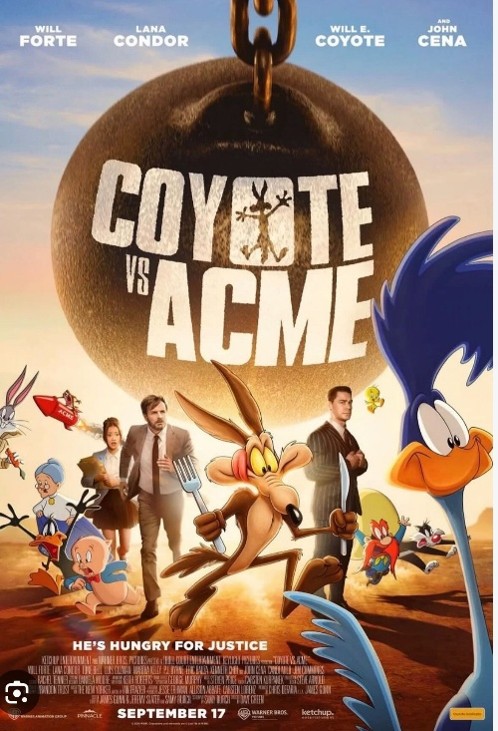
Coyote vs. Acme is a funny, surprisingly thoughtful live-action/animated comedy that takes one of the oldest jokes in the Looney Tunes universe, Wile E. Coyote’s endless failure to catch the Road Runner and asks a wonderfully absurd question: What if the Coyote finally hired a lawyer?
Directed by Dave Green and starring Will Forte, John Cena, and Lana Condor alongside familiar Looney Tunes characters, the film was released theatrically on August 28, 2026. Its premise comes from Ian Frazier’s 1990 New Yorker satire imagining Wile E. Coyote suing the Acme Corporation over its notoriously unreliable products. The result is much more than a collection of cartoon jokes. Beneath the explosions, anvils, rockets, courtroom antics, and Road Runner chases is a story about perseverance, corporate power, justice, friendship, purpose, failure, and refusing to allow repeated disappointments to destroy your hope.
Brief Summary
After yet another disastrous attempt to catch the Road Runner using Acme products, Wile E. Coyote begins to wonder whether all his failures are entirely his fault. After seeing an advertisement for a personal-injury lawyer, he hires struggling attorney Kevin Avery, played by Will Forte, and attempts to sue the powerful Acme Corporation.
Kevin initially expects another quick settlement. He has become cynical and accustomed to resolving cartoon-related claims against Acme for relatively small amounts. But Wile E. has accumulated an extraordinary number of defective products, and circumstances transform what appeared to be a ridiculous claim into a massive confrontation with Acme. Standing on the other side is Buddy Crane, played by John Cena, a formidable corporate attorney and Kevin’s former law-school associate. Kevin is also joined by his idealistic niece Paige, played by Lana Condor, whose desire to pursue justice challenges his cynicism.
What follows is part courtroom comedy, part Looney Tunes adventure, and part David-versus-Goliath story. The movie ultimately becomes less about whether Wile E. can win a lawsuit and more about what makes his seemingly endless struggle meaningful. The film has been warmly received. Its opening weekend brought in $15.5 million domestically, audiences gave it an A CinemaScore, and it debuted with a 95% Rotten Tomatoes score.
Rating: 4.5 out of 5
What surprised me most about Coyote vs. Acme is its heart. It respects the silliness of the original cartoons while finding genuine humanity in a character whose entire existence has seemingly been defined by failure.
Life Lessons for Bible Study
If any cartoon character understands failure, it is Wile E. Coyote.
He fails spectacularly.
He falls from cliffs.
Rockets explode.
Catapults malfunction.
Boulders fall on him.
Plans collapse.
Yet somehow, Wile E. gets back up. That makes him an amusing illustration of perseverance. Scripture says: “For the righteous falls seven times and rises again. Proverbs 24:16, ESV
The Christian life does not promise an absence of failure. What matters is what we do after failure occurs. Some people experience one major disappointment and allow it to define the rest of their lives. Others ask: What can God teach me through this, and how do I move forward? Wile E. Coyote’s exaggerated persistence reminds us of an important truth: falling down is not the same thing as being finished.
There is another side to Wile E.’s determination. We admire his persistence, but we should also question it. For decades he has pursued the same Road Runner, frequently using variations of the same unsuccessful methods. He is persistent but not always wise. Scripture says:
“The simple believes everything, but the prudent gives thought to his steps.” – Proverbs 14:15, ESV
There is an important difference between perseverance and stubbornness. Perseverance says: “I will not abandon what God has called me to do.” Stubbornness says: “I will keep doing things my way even when wisdom tells me to change.”
Sometimes faithfulness means continuing.
Sometimes wisdom means changing methods.
And sometimes maturity means realizing that we have been chasing the wrong Road Runner altogether. That could make an excellent Bible-study discussion question: Is there something in your life you call perseverance that may actually be stubbornness?
Wile E. has a legitimate complaint: Acme products frequently fail catastrophically. But there is an uncomfortable question behind his lawsuit: How much responsibility does Acme bear, and how much responsibility belongs to Wile E.? After all, Acme may manufacture the rocket but Wile E. straps himself to it. That tension provides an excellent biblical lesson. Galatians 6:5 says: “For each will have to bear his own load.” We live in a culture where blame can easily be transferred.
My parents caused it.
My employer caused it.
My circumstances caused it.
My spouse caused it.
Society caused it.
Sometimes other people really have wronged us, and justice matters. But spiritual maturity also requires asking: What part of this situation belongs to me? Growth begins when we stop blaming everyone else for decisions that are ultimately ours.
At its heart, Coyote vs. Acme is a David-versus-Goliath story: one seemingly insignificant individual challenges a massive corporation with enormous resources. Scripture repeatedly demonstrates God’s concern for justice. “Learn to do good; seek justice, correct oppression.” – Isaiah 1:17, ESV
Christians should never assume that wealth, influence, or institutional power automatically makes someone right. Neither should we assume that every underdog is automatically right. Biblical justice requires truth. The Christian’s responsibility is therefore not simply to choose the stronger or weaker side but to ask: What is true, what is right, and what is just?
The legal battle gradually forces Kevin to decide what kind of lawyer and what kind of man he wants to be. He can approach his profession merely as a means of surviving and making money, or he can rediscover the ideals that once gave his work meaning. Jesus asked: “For what will it profit a man if he gains the whole world and forfeits his soul?” – Matthew 16:26, ESV
The question extends far beyond attorneys. A Christian businessperson can make money and lose integrity. A leader can gain influence and lose character. A minister can build a successful ministry and lose spiritual priorities. A person can win an argument and damage a relationship. Winning is not always victory. Sometimes the greater victory is remaining faithful to your values even when doing so costs you something.
Kevin has become discouraged. Somewhere along the way, his profession stopped being about justice and became something he simply did. Paige’s idealism reminds him that his work can mean something again. That is a valuable lesson for Christians who have served for many years. Paul writes: “And let us not grow weary of doing good.” – Galatians 6:9, ESV
We can become cynical about almost anything: Marriage, Church, Ministry, Government, Work, People and even Ourselves. Cynicism protects us from disappointment by convincing us not to expect anything better. Christian hope operates differently. It recognizes how broken the world is while continuing to believe that faithfulness matters.
Everyone knows Wile E. Coyote as a loser. That is practically his identity. But the film asks viewers to see him differently. What if the person everyone laughs at deserves to be heard?
Scripture repeatedly shows God using people whom others underestimated.
David was overlooked by his family.
Gideon considered himself insignificant.
Peter failed Jesus publicly.
Paul had persecuted Christians.
Yet God saw possibilities others could not see.
First Samuel 16:7 reminds us: “For the LORD sees not as man sees: man looks on the outward appearance, but the LORD looks on the heart.” – 1 Samuel 16:7, ESV
A person’s worst failure should not necessarily become our permanent definition of that person. God specializes in writing new chapters for people others have written off.
One of the film’s most touching ideas concerns the relationship between Wile E. Coyote and the Road Runner. For generations, audiences have viewed them simply as enemies: one runs and the other chases. But Coyote vs. Acme finds surprising emotional depth in their relationship. The film ultimately suggests that underneath their endless competition is a bond neither fully appreciates until separation threatens it. That provides an interesting biblical parallel: “A friend loves at all times. – Proverbs 17:17, ESV
Friendship does not always look the way we expect. Sometimes the people who challenge us most also help us grow. Sometimes competition can become respect. Sometimes we do not recognize how important someone has become until that person is absent. Never become so accustomed to someone’s presence that you forget to appreciate them.
Wile E. Coyote has devoted his existence to one objective: Catch the Road Runner. Eventually an important question emerges: Who is Wile E. if he isn’t chasing the Road Runner? That is a surprisingly profound question. People make similar mistakes.
“I am my career.”
“I am my military rank.”
“I am my education.”
“I am my ministry.”
“I am my marriage.”
“I am my accomplishments.”
“I am my reputation.”
But what happens when those things disappear? Paul gives Christians a deeper foundation: “For you have died, and your life is hidden with Christ in God.” Colossians 3:3, ESV
For the Christian, our ultimate identity cannot rest in what we chase, accomplish, possess, or achieve. Our deepest identity rests in whose we are.
Wile E. spends his life believing happiness lies just ahead of him.
If only he can catch that bird.
That sounds remarkably familiar.
If only I get the promotion.
If only I make more money.
If only I buy that house.
If only I retire.
If only I accomplish this goal.
Then I’ll be happy.
Paul learned something different: “I have learned in whatever situation I am to be content.” – Philippians 4:11, ESV
Goals are valuable. Ambition can be healthy. Achievement is not sinful. But if our happiness always depends upon catching the next “Road Runner,” contentment will always remain just beyond our reach.
The Film’s Most Interesting Real-Life Lesson
There is an extraordinary irony surrounding Coyote vs. Acme. The movie is about a small character struggling against a giant corporation that treats him as disposable. Then, in real life, Warner Bros. announced in 2023 that it would shelve the completed movie rather than release it. After enormous public and industry criticism, the film was eventually acquired by Ketchup Entertainment for about $50 million and finally reached theaters in August 2026.
In other words, a movie about refusing to give up almost became a movie nobody would ever see—and survived because people refused to give up on it. That makes the movie itself an illustration of its message. Its history brings to mind Paul’s words: “We are afflicted in every way, but not crushed; perplexed, but not driven to despair.” – 2 Corinthians 4:8, ESV
Sometimes perseverance does not guarantee the outcome we originally wanted. But perseverance can ensure that disappointment does not have the final word.
Bible Study Discussion Questions
Final Reflection
Coyote vs. Acme succeeds because it does something unexpected. It takes a character whose entire existence has been one enormous running joke and asks us to consider the person underneath the punch line. Wile E. Coyote fails constantly. But he gets up. He loses. But he tries again. He is embarrassed. But he keeps going. And eventually we realize that his greatest characteristic may not be his cleverness at all. It is his refusal to quit.
Christians should admire that quality while adding something Wile E. often lacks: wisdom about what is worth pursuing. Hebrews 12:1 provides an appropriate concluding passage: “Let us also lay aside every weight, and sin which clings so closely, and let us run with endurance the race that is set before us.” – Hebrews 12:1, ESV
Notice that Scripture does not simply tell us to run. It tells us to run the race that is set before us. Therein lies perhaps the best Bible-study lesson from Coyote vs. Acme: Perseverance is a virtue, but wisdom determines what is worthy of our perseverance. Wile E. Coyote spent his life refusing to quit. The Christian must go one step further: Make sure what you refuse to quit is something God actually wants you to pursue.
Be the first to know about our latest updates, tips and special offers.
Copyright © 2022 All Rights Reserved
Website designed by Red Robin Designers.